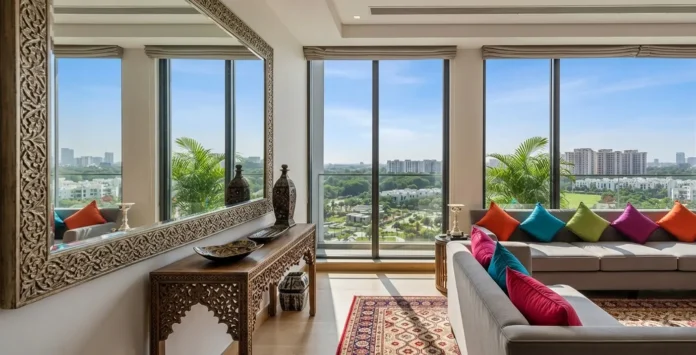
A beautiful living room or premium amenities may catch your attention first, but your everyday comfort often depends on how thoughtfully the community is planned. The distance between towers, the number of shared walls and the orientation of windows and balconies all influence how private your home feels. Looking beyond the brochure can help you make a more informed decision.
How Should You Compare Apartment Privacy?
Apartment privacy is shaped by the overall design of the development, not just the size of your home. While visiting a project, look at the master plan, floor plans and building layout together. These details often reveal far more about your future living experience than attractive visual renders alone.
How Does Tower Spacing Affect Apartment Privacy?
The distance between residential towers plays a significant role in maintaining visual privacy. Greater separation can reduce direct views into neighbouring homes while allowing more natural daylight and airflow to enter each apartment. Towers that are positioned very close together may feel more enclosed, especially if balconies or living rooms face one another.
Instead of relying only on marketing visuals, ask to see the approved master plan. Request the actual tower-to-tower distance wherever available and observe whether your living room or balcony overlooks another building, landscaped areas, internal roads or more open surroundings. As every project is different, buyers should avoid assuming that one specific distance is suitable for all developments unless supported by approved plans or applicable regulations.
Why Do Shared Walls Matter?
A common wall is a wall shared by two adjoining apartments. Homes with more shared walls may be more exposed to noise from neighbouring residences, although this depends heavily on the construction and layout.
Corner apartments often have fewer adjoining units, which may contribute to a greater sense of privacy. However, a project that advertises “no common walls” should not automatically be assumed to be completely soundproof. Wall construction, material quality, thickness, workmanship and the placement of service ducts all influence acoustic privacy. These are useful questions to ask during a site visit.
How Should Buyers Check Window and Balcony Orientation?
Window and balcony placement can have a noticeable impact on everyday comfort. Bedroom and bathroom windows should ideally avoid facing frequently used neighbouring spaces at close range. Similarly, balconies positioned directly opposite one another may reduce visual privacy.
Design features such as angled windows, corner layouts and views towards open spaces can improve separation between homes. Orientation, together with window placement and the apartment layout, can influence natural light, ventilation and indoor heat throughout the day. Buyers should review the floor plan carefully and, whenever possible, visit the site at different times to understand how the surroundings feel in real-world conditions.
What Else Should Be Checked Beyond the Apartment Plan?
Privacy isn’t determined by the apartment layout alone. The wider building design matters too.
Privacy Factor
What to Check
Lobby density
How many households share the same lobby
Lift placement
Whether apartment doors open directly towards the lift or another home
Corridor layout
Whether people regularly pass bedroom or living-room windows
Service ducts
Whether plumbing noise may travel between apartments
Amenity location
Potential noise from pools, clubhouses or children’s play areas
A Practical Example: Privacy Planning at Solcrest
According to the official project information, Solcrest is planned across 9.3 acres with six towers and 796 residences. The project also states that it offers four units per floor, no common walls, homes facing open skies, east-west oriented balconies and approximately 90% open space and also 20 feet long curved balconies.
These planning decisions may contribute to a greater sense of openness and privacy. However, prospective buyers should always verify such details through the official floor plan, master plan, RERA documents and booking specifications before making a purchase.
This verification process applies whether you’re evaluating Bricks & Milestones or any other premium apartment builder in Bangalore.
Conclusion
Apartment privacy depends on thoughtful planning rather than a single feature. Taking time to evaluate tower spacing, shared walls, window orientation and the overall site layout can help you choose a home that feels comfortable for years to come.
FAQs
Are corner apartments more private?
Corner apartments often have fewer adjoining units, which may improve privacy. However, overall privacy also depends on tower spacing, window orientation and the building layout.
Does having no common walls prevent noise?
Not necessarily. Acoustic privacy is also influenced by wall materials, construction quality, wall thickness, service ducts and workmanship.
How can buyers check tower-facing views?
Review the approved master plan and floor plans, ask about tower-to-tower distances, and visit the site to understand what your windows and balconies will actually overlook.
Does a higher floor provide more privacy?
A higher floor may reduce exposure to street-level activity, but it doesn’t automatically guarantee privacy. The direction of neighbouring towers, balconies and windows still matters.
What should buyers check for privacy during a site visit?
Check what the main windows and balconies face, how close neighbouring towers appear, whether apartment doors face one another, the number of homes sharing the floor and the proximity of the unit to lifts and busy amenities.

