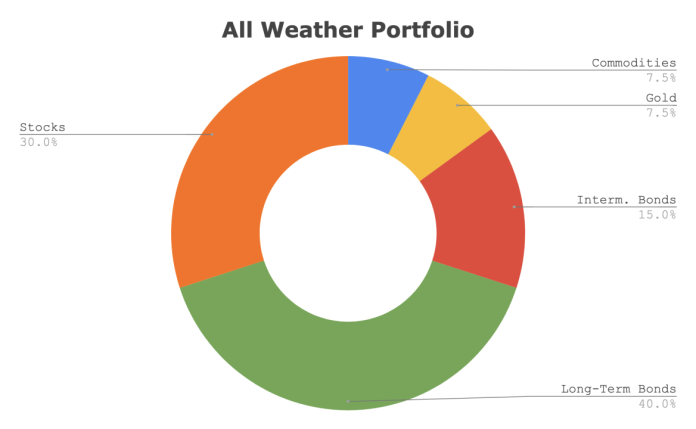
The Indian stock market, while offering critical development potential, is likewise known for its volatility. Changes in the Clever 50 and Sensex can be disrupting for investors, especially those with a lower risk tolerance. In this unique situation, the all-weather portfolio strategy has gotten forward momentum as an approach to potentially moderate gamble and accomplish reliable returns paying little heed to market conditions. This post investigates the center standards of this methodology and its significance to the Indian investor.
Key Insights
The all-weather portfolio strategy, promoted by Beam Dalio, intends to make a portfolio that performs well across various monetary conditions. It accomplishes this by differentiating speculations across resource classes that respond diversely to monetary movements. In the Indian setting, this typically includes a blend of values, fixed pay, gold, and potentially land. The allocation to every resource class depends on its historical execution and relationship with other resource classes. For instance, during times of high expansion, gold has frequently gone about as a fence in India, while fixed pay will in general perform better when loan fees are declining.
A key component of this strategy is understanding the exchange between various market factors and resource execution. At the point when the Indian economy is blasting, and the Clever 50 is taking off, values structure a huge piece of the portfolio. Notwithstanding, when financial development eases back, or expansion rises, the portfolio automatically rebalances to expand openness to gold and fixed pay. This rebalancing is pivotal, as it guarantees the portfolio stays lined up with the changing market elements. For example, on the off chance that the exchanging volume of the Initial public offering market evaporates, flagging a possible lull, the all-weather portfolio would probably lessen its value openness.
Applying this strategy in India requires cautious thought of the particular attributes of the Indian market. While the overall standards continue as before, the particular resource allocation might require changes. For instance, the job of land in an all-weather portfolio can be discussed. While it can offer expansion, its liquidity can be a worry. Essentially, the allocation to global values, however acquiring prominence, should be assessed considering SEBI guidelines and cash risk. Examining historical information of the Sensex and other applicable files can assist with deciding the ideal resource allocation for the Indian setting.
Another significant highlight note is that the all-weather portfolio isn’t tied in with amplifying returns in any single market condition. All things being equal, it expects to convey predictable, moderate returns over the long haul, limiting the effect of market slumps. This makes it especially appropriate for long haul investors, like those putting something aside for retirement. It’s significant that the previous presentation isn’t demonstrative of future outcomes, and standard portfolio audits and rebalancing are fundamental for the progress of this strategy.
Conclusion
Understanding the all-weather portfolio strategy: Adapting to market volatility of the Indian stock market. By expanding across resource classes and rebalancing periodically, investors might potentially accomplish more steady returns over the long haul. Be that as it may, it’s significant to grasp the subtleties of the Indian market, think about individual gamble tolerance, and direct intensive exploration prior to executing this strategy. While it’s anything but an assurance against misfortunes, it very well may be a significant tool for building a strong portfolio.
Final Thoughts
For further perusing, investigating assets on resource allocation and portfolio rebalancing can be valuable. Talking with a certified monetary counselor is likewise prescribed to fit the strategy to your particular monetary objectives and hazard profile. Understanding market capitalization patterns and the more extensive financial viewpoint can further upgrade the execution of this methodology.
Smart investing requires informed decision-making. Online financial calculators offer valuable tools for investors to assess potential returns and costs. From calculating brokerage and margin to planning lump-sum investments, these resources provide greater transparency. For long-term growth, SIPs offer a disciplined approach, and SIP calculators can help visualize the potential returns. These tools empower investors to take control of their financial future. Explore the benefits of using these resources to make informed investment choices.

